Text-based Platform
The "voice" here is like a fast-paced social news plaza, rapidly focusing on practical policy issues and public anxieties, filled with immediate complaints and feedback.
Despite the proven efficacy of HPV vaccines, uptake remains limited in many regions, including China.
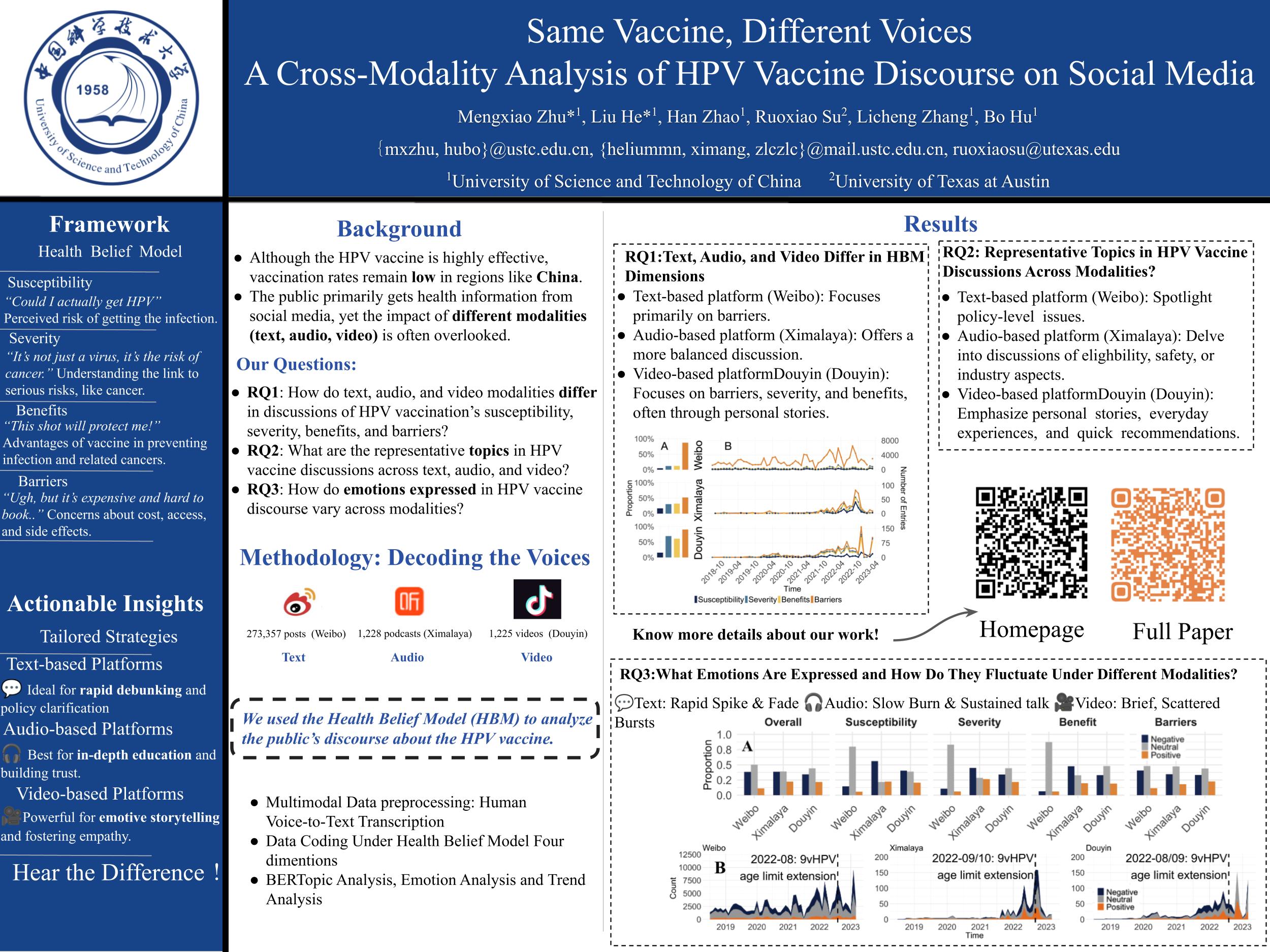
This study investigates how health beliefs and emotional responses evolve across text-, audio-, and video-based platforms by analyzing data from three representative platforms in China, including 273,357 posts from Weibo (text-based), 1,228 podcasts from Ximalaya (audio-based), and 1,225 videos from Douyin (video-based) from July 2018 to March 2023. The comparisons are conducted under four dimensions as suggested by the Health Belief Model (HBM), including susceptibility, severity, benefits, and barriers. Our findings reveal distinct modality-specific patterns. For instance, a text-based platform tends to amplify barriers and negativity, an audio-based platform enables balanced and sustained discussions, and a video-based platform highlights personal anecdotes and drives rapid sentiment shifts.
By highlighting these modality-specific differences and addressing potential cross-modal incongruities at the content level, we provide actionable insights for public health communicators, policymakers, and platform designers to tailor strategies, foster informed decision-making, and ultimately enhance HPV vaccine uptake in complex social media ecosystems.
Inspired by the classic communication theory that "the medium is the message," our research investigates how public discourse on a single topic—the HPV vaccine—is fundamentally reshaped by the social media modality that carries it. To systematically analyze how these voices differ across text, audio, and video, we employed the Health Belief Model (HBM) as our core analytical framework.
The "voice" here is like a fast-paced social news plaza, rapidly focusing on practical policy issues and public anxieties, filled with immediate complaints and feedback.
The "voice" here is more like an in-depth roundtable interview, providing ample space for complex topics and fostering discussions that are more balanced, rational, and in-depth.
The "voice" here is a vivid personal story-sharing session, driven by strong emotional resonance and dramatic individual narratives. The topics of discussion are often fragmented and change rapidly.
The findings from this study offer practical guidance for health communication strategies:
@article{SameVaccine2025,
  volume={19},
  url={https://ojs.aaai.org/index.php/ICWSM/article/view/35936},
  author    = {Zhu, Mengxiao and He, Liu and Zhao, Han and Su, Ruoxiao and Zhang, Licheng and Hu, Bo},
  title     = {Same Vaccine, Different Voices: A Cross-Modality Analysis of HPV Vaccine Discourse on Social Media},
  journal   = {Proceedings of the International AAAI Conference on Web and Social Media},
  year      = {2025},
  month     = {Jun.},
  pages     = {2317-2333}
}